Physical Address
304 North Cardinal St.
Dorchester Center, MA 02124
Physical Address
304 North Cardinal St.
Dorchester Center, MA 02124

Industrial digitalization is a transformation that changes how we operate across various sectors. One area undergoing significant change is smart manufacturing, where digital technology is used to enhance efficiency, productivity, and product quality. Nocola, as a technological platform that educates and provides innovative solutions, plays a critical role in facilitating this process. This article will discuss how Nocola contributes to industrial digitalization through the implementation of smart manufacturing.

Smart manufacturing is an approach that utilizes digital technology and automation to improve efficiency and responsiveness in the production process. It involves the use of the Internet of Things (IoT), artificial intelligence (AI), and data analytics to provide rich insights and the ability to quickly adapt to changes in market demand.
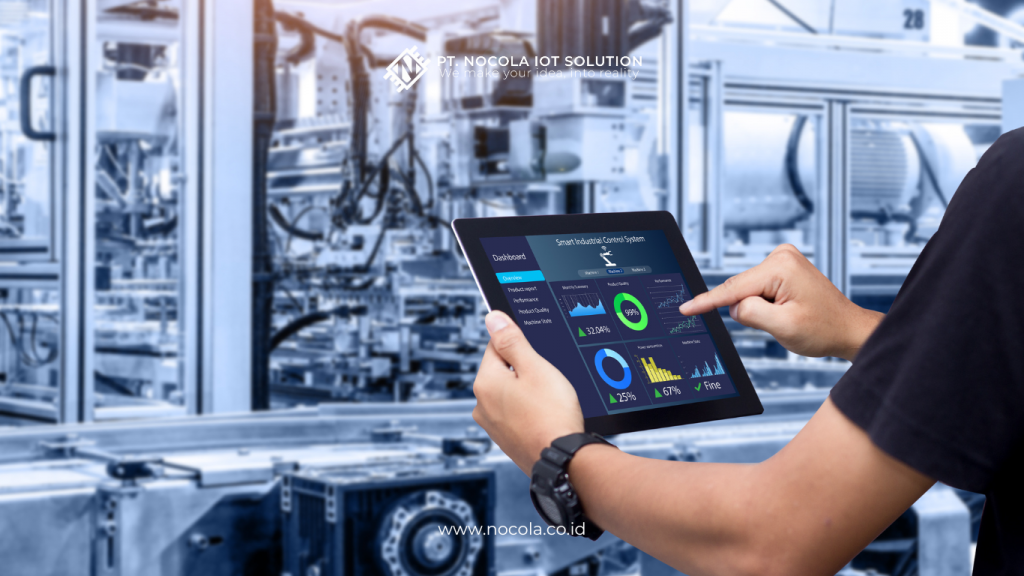
In the midst of this paradigm shift, Nocola stands out as a key supporter in facilitating the transition to smart manufacturing. We offer tools, resources, and insights for industries to undergo digital transformation. Let’s take a closer look at Nocola’s role in industrial digitalization.
One of the most critical aspects of industrial digitalization is education and training. Many companies have not fully understood the new technologies available. Nocola provides educational programs and training to help professionals grasp the concepts of smart manufacturing and how to implement them in their businesses.
Nocola collaborates with Flux.id to offer IoT solutions that enable companies to integrate devices and sensors to monitor production processes in real-time. By collecting and analyzing data from machines, companies can optimize their operations and improve efficiency.
Nocola also collaborates with CEMS.id, which provides emission monitoring technology. In smart manufacturing, monitoring and reducing carbon emissions generated during the production process is essential. This collaboration helps companies comply with environmental regulations while enhancing operational efficiency.
Managing data efficiently is key in digitalization. Nocola collaborates with Logsheet.digital to provide digital recording solutions that allow companies to manage production data in real-time. With an integrated system, companies can reduce errors and improve accuracy in recording.
In certain industries, such as food and beverage manufacturing, the importance of water quality cannot be ignored. Nocola works with WQMS.online to ensure that companies can accurately monitor water quality. This supports the overall sustainable production process.

Industrial digitalization offers several benefits for companies:
By implementing digital technology, companies can optimize production processes and enhance efficiency. For example, process automation can reduce downtime and lower operational costs.
With data analytics, companies can make faster and more accurate decisions. Real-time data allows managers to understand existing trends and patterns, enabling decisions based on facts rather than assumptions.
Digital technology not only allows for cost reduction but also enhances product quality. By accurately monitoring the production process, companies can identify defects or issues early, thus reducing the number of defective products.
In this fast-paced era, companies need to be more responsive to changing market demands. Digitalization enables companies to quickly adapt to consumer demand, preparing them for fluctuating market segments.
While the benefits are clear, implementing smart manufacturing is not without challenges. Here are some common challenges faced by companies:
One of the biggest hurdles for many companies is the initial cost of adopting new technologies. While these technologies can save money in the long run, the upfront investment in hardware and software can be a barrier.
There is a shortage of skilled labor in the field of digital technology, including IoT and AI. This can limit a company’s ability to leverage these technologies effectively.
As companies begin to collect and manage more data, the risks associated with data security also increase. It’s crucial to have appropriate security measures to protect sensitive information from cyber threats.
Many employees may feel threatened by the implementation of automation and new technologies. Managing change and educating employees about the benefits of new technologies is vital for the success of digital transformation.
Nocola plays a crucial role in facilitating industrial digitalization through the implementation of smart manufacturing. By providing education, technological solutions, and valuable collaboration, Nocola helps companies improve efficiency, reduce costs, and enhance product quality.
The use of technology will continue to evolve, and it’s time for every business to adapt to these changes. Nocola will keep innovating and contributing to broader industrial advancements, and we invite every professional to join us on this journey toward a smarter and more efficient future.

