Physical Address
304 North Cardinal St.
Dorchester Center, MA 02124
Physical Address
304 North Cardinal St.
Dorchester Center, MA 02124


As the population continues to grow and urbanization increases, cities around the world face significant challenges in managing infrastructure, transportation, and public services. This is where Ultra WideBand (UWB) positioning emerges as a key innovation. It offers high accuracy and can be used across various sectors, from logistics to healthcare. In this article, we will explore what UWB positioning is, how it works, its applications in everyday life, and the benefits it offers for businesses and users.

Ultra WideBand (UWB) is a wireless communication technology that uses a very wide frequency range to transmit data. Unlike traditional communication technologies, UWB sends signals in the form of very short pulses, allowing for data transmission over greater distances and with higher accuracy.

UWB uses time measurement techniques to determine the position of devices. By calculating the time it takes for the signal to travel from the transmitter to the receiver, the system can accurately determine the distance. At least three receivers are needed to establish the location of the device.
A typical UWB system consists of several components:
The measurement process begins when the tag sends a signal to several receivers simultaneously. Each receiver records the time the signal is received and sends this information to the central server for further calculations.

UWB offers unprecedented accuracy in locating devices. With a margin of error of only a few centimeters, it is the ideal solution for applications requiring high precision.
Due to its wide bandwidth, UWB tends to be more resistant to interference from other signals. This makes it an ideal choice in signal-dense environments such as office buildings or shopping centers.
UWB can provide accurate location data even in conditions where signals are reflected off various surfaces, such as walls and furniture. This is particularly helpful in creating better indoor tracking experiences.
UWB has a range of applications, from vehicle and asset tracking to healthcare applications for patient monitoring and wearable devices.
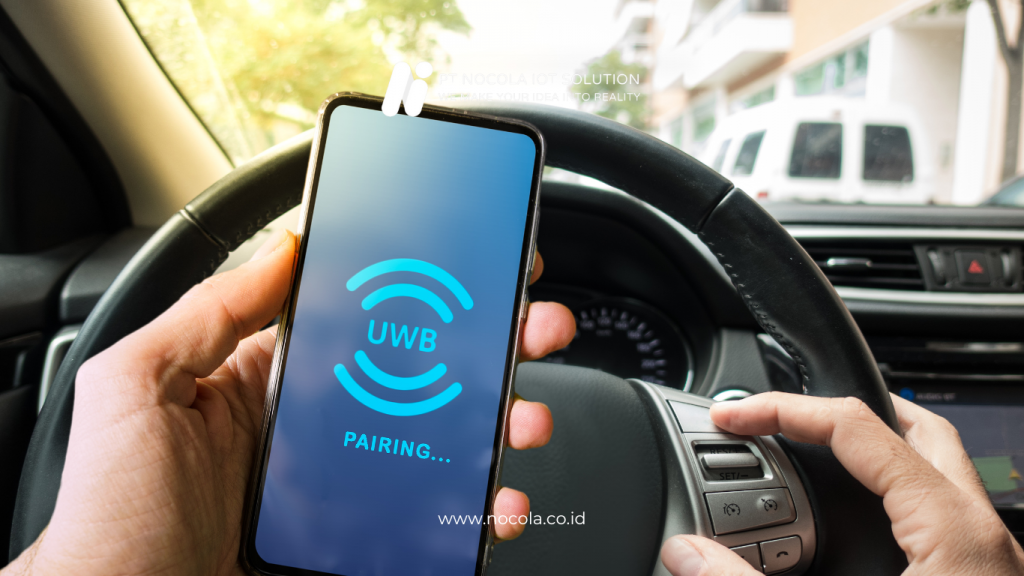
In the logistics industry, UWB is used to track and manage inventory in real time. With high accuracy, companies can optimize their inventory management, reduce asset losses, and improve operational efficiency.
In the healthcare sector, UWB is applied for monitoring patients using wearable devices. This system can track the location of patients within hospitals and provide real-time information to medical staff.
In the context of smart homes, UWB can be used for access control and security, as well as to manage devices more easily and efficiently.
UWB technology can be applied for a more immersive gaming experience, with real-time tracking of player positions, enhancing interactivity.
As more businesses recognize the benefits of UWB technology, adoption is expected to rise across various sectors, opening new opportunities for innovation.
UWB is expected to become increasingly integrated with other technologies such as AI and machine learning, adding more value across a variety of applications.
Given the need to reduce carbon footprints and improve efficiencies, UWB can contribute to creating more environmentally friendly and sustainable solutions.
LoRa is a technology poised to transform how we communicate and interact with devices in our surroundings. With its capacity to wirelessly connect devices efficiently, LoRa offers ideal solutions for various applications within the IoT landscape.

