Physical Address
304 North Cardinal St.
Dorchester Center, MA 02124
Physical Address
304 North Cardinal St.
Dorchester Center, MA 02124

Awareness of the importance of a healthy environment continues to rise, and the Indonesian government is tightening regulations related to emissions and air quality. The manufacturing, energy, oil and gas, mining, and waste management industries are required to monitor and report environmental conditions in real-time. In this context, two technologies have become crucial: Air Quality Monitoring System (AQMS) and Continuous Emission Monitoring System (CEMS).
However, the biggest challenge for companies is ensuring that all monitoring data is accurate, real-time, and compliant with government standards. This is not only to meet reporting obligations but also to avoid penalties, environmental audits, and to maintain brand trustworthiness.
This is where the technological innovation from Nocola IoT Solutions comes into play, offering significant change. With more precise, flexible, and easily integrated IoT-based AQMS and CEMS, companies can operate industrially in a more responsible manner while complying with regulations.
This article thoroughly discusses how Nocola’s AQMS and CEMS solutions help companies meet regulatory requirements, reduce violation risks, and enhance operational efficiency.

AQMS is a technology-based system designed to monitor air quality in the environment around industries. Parameters that are monitored include:
AQMS is key for companies to understand the operational impacts on the surrounding environment and to keep the air quality within safe limits.
In other words, AQMS maintains a harmonious relationship between industry and the community.

CEMS is a system used to monitor gas emissions from industrial stacks. Measured parameters include:
CEMS is a regulatory requirement for many industries, especially those producing significant emissions such as coal-fired power plants (PLTU), cement factories, fertilizer plants, and smelters.
The Indonesian government (KLHK) mandates CEMS installation to:
CEMS is not just a monitoring device. It is a compliance tool.

Several regulations form the basis of the mandatory implementation of AQMS and CEMS:
Regulates environmental quality standards and management procedures.
Regulates the obligation for continuous emission monitoring (CEMS).
Regulates the obligation for real-time environmental data submission to KLHK.
Forms the basis for environmentally friendly industrial operations.
Companies that do not comply may face:
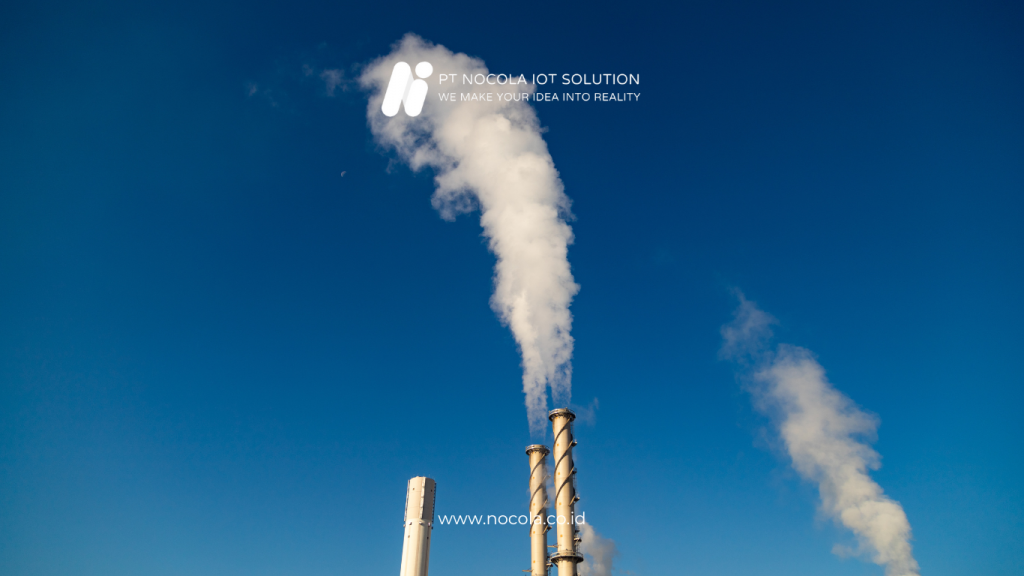
Nocola’s solutions are specifically designed to meet the needs of the Indonesian industry and are fully compatible with KLHK standards. Here are the benefits:
Nocola’s AQMS and CEMS sensors have very high accuracy and are always calibrated.
Advantages:
One of the main advantages of Nocola’s system is its ability to integrate directly into the government reporting system.
Benefits:
The Nocola system includes threshold-based alert features.
When parameters exceed safe limits:
AQMS and CEMS are designed to withstand:
Less maintenance is required, leading to reduced downtime.
Nocola provides a cloud-based dashboard accessible via:
Features:
Another advantage of Nocola’s technology:
– Local components = cheaper
– Local technicians = quick response
– Available spare parts = no waiting for imports
Industries save 20–40% compared to importing CEMS.
With historical data dating back years:
Companies no longer need to rely on manual record-keeping.
| Feature | Conventional System | Nocola AQMS & CEMS |
|---|---|---|
| Real-time | Inconsistent | Stable 24/7 |
| KLHK Integration | Not automatic | Fully automated |
| Notifications | Manual | Real-time automatic |
| Maintenance | Expensive | More efficient |
| Dashboard | Complex | User-friendly |
| Historical Data | Limited | Up to years |
Environmental regulations in Indonesia are becoming stricter, and companies are required to act more transparently, accurately, and responsibly. In this climate, AQMS and CEMS are no longer options; they are essential obligations for companies.
Nocola’s AQMS and CEMS solutions provide answers for industries that want to:
With reliable local IoT technology, automatic integration, and real-time monitoring, Nocola helps companies face environmental challenges with greater confidence.

