Physical Address
304 North Cardinal St.
Dorchester Center, MA 02124
Physical Address
304 North Cardinal St.
Dorchester Center, MA 02124

The issue of industrial emissions is a major concern in the modern era, as demands for environmental sustainability and regulatory compliance increase. Industries across various sectors, from power generation, manufacturing, to waste processing, are required to strictly and measurably control exhaust emissions. Without a reliable monitoring system, the risk of regulatory violations and environmental impact can rise significantly.
This is where CEMS Nocola (Continuous Emission Monitoring System) plays a vital role. With continuous and real-time emission monitoring technology, CEMS Nocola helps industries not only monitor emissions but also manage them in a more controlled and data-driven manner. This system is designed to support more transparent, efficient industrial operations that comply with environmental standards.
This article will discuss how CEMS Nocola assists industries in controlling emissions, from the challenges faced to the strategic benefits generated.

Also Read: Why CEMS is Important for Regulatory and Environmental Compliance?
Controlling emissions is not a simple task. Many industries still rely on periodic or manual measurement methods that fail to capture emissions comprehensively. These methods often lead to delays in detecting emission spikes that could potentially violate regulatory limits.
Additionally, inconsistent emission data scattered across multiple systems complicates the analysis process. Environmental and operational teams must gather data from various sources, increasing the risk of errors and data discrepancies.
Another challenge is the increasing environmental standards and regulations. Government and regulatory agencies demand accurate, documented emission data that is easily accessible for auditing purposes. Without the right systems in place, industries risk facing administrative sanctions and reputational damage.
This situation highlights the need for solutions that can continuously and integratively monitor emissions.

CEMS, or Continuous Emission Monitoring System, is a system used to continuously monitor exhaust gas emissions at industrial emission sources. This system works by measuring various emission parameters in real-time and then sending that data to a central monitoring system.
The role of CEMS in industry is crucial. With continuous monitoring, industries can know their emission conditions at any time without waiting for manual measurement results. This allows for early detection of potential emissions violations.
CEMS also serves as a tool to support regulatory compliance. The data generated can be used as official reporting evidence to regulators. With a well-documented system, industries have higher data transparency and can accountable for their environmental performance.
As a modern solution, CEMS is an important part of a sustainable industrial environmental management strategy.

CEMS Nocola is designed to operate accurately and reliably in dynamic industrial conditions. This system employs sensors and analyzers that are directly installed on the chimney or emission source. The measured emission data is then automatically sent to the monitoring platform.
The advantage of CEMS Nocola lies in its integration of real-time data. Incoming information is displayed in an easy-to-understand dashboard, complete with graphs, historical data, and notifications. With this display, operational teams can monitor emission conditions directly and take action if anomalies occur.
Moreover, this system supports long-term data storage. Historical emission data can be used for trend analysis, performance evaluation, and the preparation of periodic reports. Thus, CEMS Nocola functions not just as a monitoring tool but also as a comprehensive emission data management system.
This approach helps industries proactively control emissions rather than reactively.

One of the main benefits of CEMS Nocola is the increase in operational efficiency. With automated monitoring, industries can reduce their dependence on time-consuming and costly manual measurements. Teams can focus more on corrective actions and process optimization.
From a regulatory compliance perspective, CEMS Nocola simplifies reporting. Emission data is neatly stored and can be accessed at any time when needed. This is particularly helpful during audits or inspections by authorities.
Additionally, the notification system allows industries to respond more quickly when emissions increase. Corrective actions can be taken before problems escalate into serious violations. With better control, the risks of sanctions and operational disruptions can be minimized.
Another benefit is the enhanced trust of stakeholders. Data transparency in emissions demonstrates the industry’s commitment to responsible environmental management.
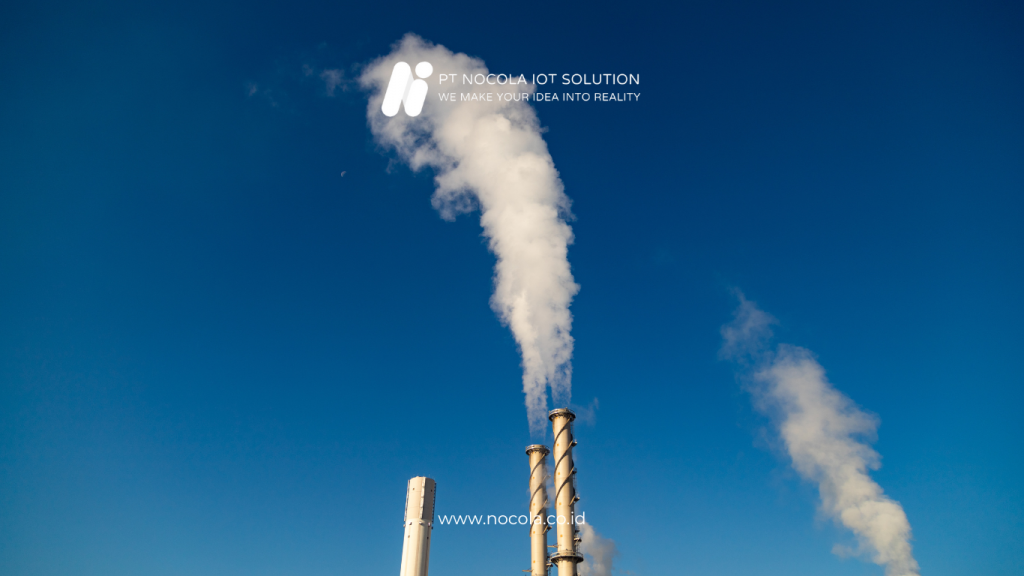
Amid increasing demands for sustainability, CEMS Nocola presents a relevant long-term solution. This system can be integrated with other digital solutions, supporting the overall digital transformation of industries.
With accurate and real-time data, industries can develop more effective emission reduction strategies. Historical data analysis helps identify the largest emission sources and determine appropriate corrective actions.
CEMS Nocola also promotes a data-driven work culture. Operational and environmental decisions are no longer based on assumptions but on measurable and accountable information.
As part of the industrial IoT ecosystem, CEMS Nocola helps companies move towards more efficient, transparent, and environmentally friendly operations.
Emission control is a significant challenge for modern industries, especially amid increasingly stringent environmental regulations. Without a reliable monitoring system, the risks of violations and environmental impact are hard to avoid.
Through Nocola’s industrial CEMS, companies can continuously, in real-time, and integratively monitor emissions. This system helps industries control emissions better, improve operational efficiency, and ensure compliance with regulations.
