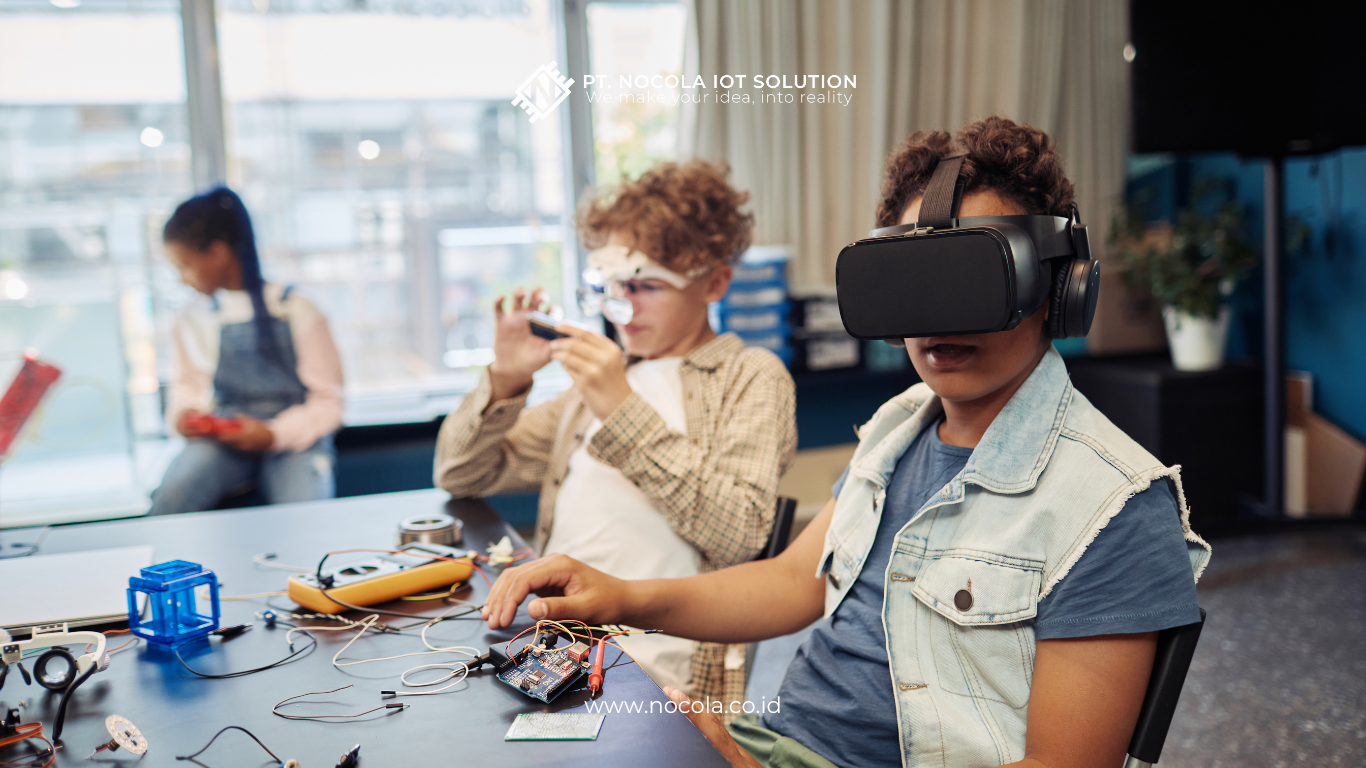
Technology has become an integral part of our daily lives, including in the world of education. Two technologies that are gaining increasing attention are Virtual Reality (VR) and Augmented Reality (AR). Both offer new, engaging, and interactive ways to learn and teach. This article will delve into how VR and AR are used in education, their benefits, the challenges faced, and their future.
Virtual Reality (VR) is a technology that allows users to enter a computer-generated virtual environment. Using a VR headset, users can feel as though they are in a completely different world. This technology allows interaction with virtual objects and environments in a realistic manner.
Augmented Reality (AR), on the other hand, is a technology that overlays virtual elements onto the real world. Through devices such as smartphones or special glasses, users can see virtual objects that appear within their real environment. AR adds digital information and objects to the real world, enhancing the user’s experience without isolating them from their surroundings.
Interactive and Immersive Learning VR and AR offer more interactive and immersive learning experiences compared to conventional methods. Students can directly interact with learning materials, such as exploring the human body in biology class or visiting historical sites in history class.
Facilitates Remote Learning These technologies are highly useful for remote learning. With VR, students can attend virtual classes and feel as if they are in a physical classroom. AR allows teachers to provide visual explanations that students can access from their homes.
Enhances Understanding and Information Retention The use of visuals and interactions in VR and AR helps improve understanding and retention of information. Studies show that learning with these technologies makes it easier for students to remember the material taught.
Simulations and Practical Training VR is very effective for simulations and practical training. For example, medical students can practice procedures without risk to real patients. AR also helps provide visual guidance during practical tasks.
Motivates and Engages Students These advanced technologies make learning more enjoyable and engaging. Students are more motivated to learn when they can experience unique and immersive experiences.
Science Lessons VR allows students to explore outer space, delve into atomic structures, or even conduct hazardous chemical experiments in a safe virtual environment. AR can be used to display 3D models of molecules or planets that can be studied interactively.
History and Geography Lessons With VR, students can visit historical sites or explore various countries without leaving the classroom. AR allows teachers to display interactive maps and historical objects directly in front of students, making learning more vivid.
Art and Design Lessons Students can use VR to create art in a 3D environment or design buildings and structures with high precision. AR allows students to see art in real-world contexts, such as placing virtual sculptures in the schoolyard.
Technical and Vocational Training VR is useful in technical and vocational training. Students can practice operating machines or heavy equipment in realistic simulations. AR helps provide step-by-step guidance during technical tasks.
Special Education VR and AR are also beneficial for students with special needs. These technologies can be customized to assist students with learning disabilities or autism, providing a more accessible and personalized learning experience.
Cost and Accessibility VR and AR devices are still relatively expensive, especially for schools with limited budgets. Accessibility to this technology is a major challenge, particularly in rural areas or developing countries.
Technology Limitations Despite rapid advancements, VR and AR technologies still have limitations. Issues such as latency, graphic quality, and user comfort remain challenges that need to be addressed.
Need for Teacher Training Implementing VR and AR requires teachers to be trained in using these technologies. Ongoing training and education for teachers are key to successfully integrating VR and AR into the curriculum.
Despite facing various challenges, the future of VR and AR in education looks very promising. With rapid technological advancements, the cost of devices will become more affordable, and the quality and comfort of their use will improve. Educational content developers are also increasingly focusing on creating relevant and high-quality materials.
The integration of VR and AR in education will expand, enabling deeper and more personalized learning experiences. Collaboration between educational institutions, governments, and technology companies will be key to bringing these technologies to more schools and students worldwide.
Conclusion
Virtual Reality (VR) and Augmented Reality (AR) are bringing a revolution to the world of education. These technologies offer new, engaging, and interactive ways to learn and teach, enhancing understanding, information retention, and student motivation. Although there are challenges related to cost, accessibility, and content development, the future of VR and AR in education is very promising. With the right collaboration and investment, these technologies can provide significant benefits to students and teachers, creating a more innovative and effective learning environment.