Physical Address
304 North Cardinal St.
Dorchester Center, MA 02124
Physical Address
304 North Cardinal St.
Dorchester Center, MA 02124


Air pollution and industrial emissions have become major concerns for governments, communities, and industrial stakeholders. Companies in the power generation, manufacturing, cement, petrochemical, and waste treatment sectors are required to manage their emissions in a transparent and responsible manner.
However, many companies still rely on periodic measurements or manual sampling to understand the condition of stack emissions. This approach is no longer sufficient amid increasingly strict regulations and the growing demand for fast and accurate data.
This is where real-time emission monitoring becomes essential. With continuous monitoring, companies can identify emission conditions instantly, rather than waiting for reports to be compiled and finalized.
CEMS, or Continuous Emission Monitoring System, is a technological solution that enables companies to monitor exhaust gas emissions automatically, continuously, and in an integrated digital environment.
This article discusses why real-time emission monitoring is critical and how CEMS plays an important role in supporting more compliant, efficient, and sustainable industrial operations.

In many industrial facilities, emission measurements are still performed using periodic methods. Teams collect flue gas samples at certain intervals and then analyze them in laboratories or using portable instruments.
This method has several fundamental limitations. First, the data obtained does not represent continuous emission conditions. Any changes that occur outside the sampling period are not recorded.
Second, manual measurements require significant time and resources. Teams must visit the site, prepare the equipment, and ensure that sampling procedures comply with established standards.
Third, the results are only available after the analysis process is completed. This means that if an emission spike occurs, the company becomes aware of it only after the event has already passed.
This situation increases the risk of non-compliance with emission limit standards. Without continuous monitoring systems, companies lack full visibility of actual stack conditions.
In addition, manual data recording increases the risk of human error, data inconsistency, and difficulties in preparing environmental reports.
Amid growing demands for transparency and regulatory compliance, conventional approaches are becoming increasingly inadequate. Industries need emission monitoring systems that operate automatically, accurately, and are accessible in real time.

Real-time emission monitoring provides significant benefits for companies, especially in maintaining compliance with environmental regulations.
With real-time systems, companies can monitor emission values at any moment. When certain gas concentrations approach or exceed regulatory thresholds, the system can immediately issue alerts.
This enables operational teams to take corrective actions promptly, such as adjusting combustion processes, regulating fuel supply, or inspecting emission control equipment.
Real-time monitoring also helps companies understand emission patterns under different operating conditions. Changes in production load, equipment start-up, or maintenance activities can be analyzed using continuously recorded data.
From a compliance perspective, real-time data simplifies environmental reporting. The data is automatically stored and can be traced and retrieved whenever required.
In addition, real-time emission monitoring enhances transparency. Companies have objective data to demonstrate their commitment to environmental management.
In the context of sustainability, real-time monitoring serves as a critical foundation for evaluating and improving production processes to become more environmentally friendly.

CEMS, or Continuous Emission Monitoring System, is a system designed to continuously monitor exhaust gas emissions from industrial stacks.
The system consists of sensors or analyzers installed at measurement points, a sampling system, and data processing equipment that transmits measurement results to a server or monitoring dashboard.
CEMS is capable of measuring various emission parameters, including specific gas concentrations, as well as supporting parameters such as temperature, pressure, and exhaust gas flow rate.
Through digital systems, measurement data is displayed in real time on a dashboard. Users can monitor emission conditions, view trends, and perform historical analysis.
CEMS integrated with digital platforms, such as those developed within the Nocola ecosystem, allows emission data to be directly connected to monitoring and reporting systems.
In addition to functioning as a monitoring tool, CEMS also serves as a primary data source for environmental reporting to regulators and other stakeholders.
With an integrated system, companies can manage emission data in a more structured, secure, and easily accessible manner.
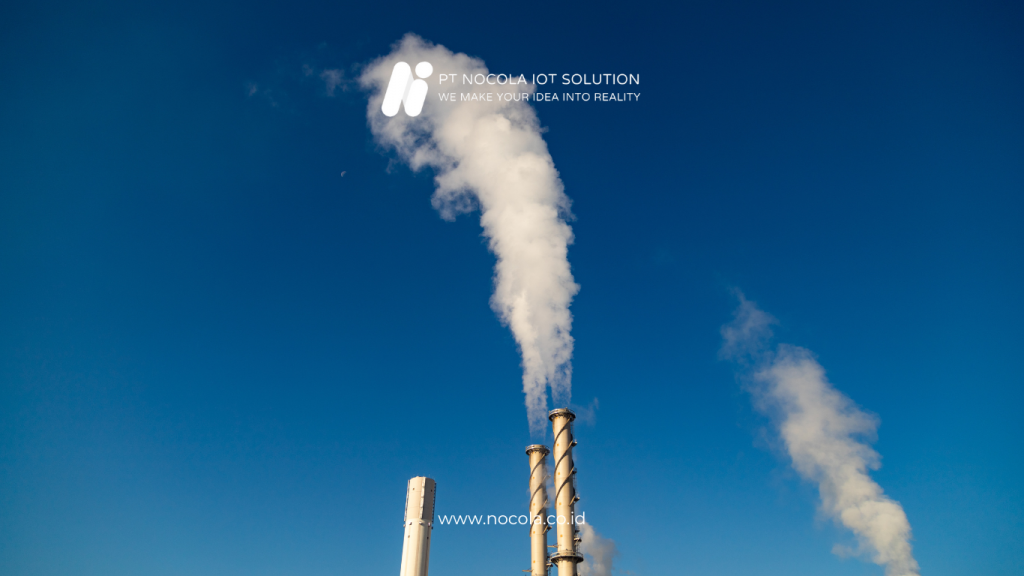
The implementation of CEMS not only supports regulatory compliance, but also delivers added value for operational efficiency.
By knowing emission conditions in real time, operational teams can optimize production processes. Combustion or chemical reaction processes can be adjusted to become more stable and efficient.
CEMS also helps detect potential issues in emission control equipment such as scrubbers, bag filters, or electrostatic precipitators. Changes in emission patterns can serve as early indicators of declining equipment performance.
Through historical data, companies can perform analysis to determine more accurate maintenance schedules. This approach supports the implementation of condition-based maintenance.
Furthermore, CEMS data can be used to evaluate emission reduction strategies. Companies can compare performance before and after implementing specific technologies.
In the long term, the use of CEMS helps companies establish more measurable and data-driven environmental management systems.
With proper management, companies can strengthen their reputation as environmentally responsible industrial operators.

To maximize the benefits of CEMS, the system must be integrated with corporate digital systems and monitoring platforms.
Through integration, emission data is not only presented as numerical values, but can also be correlated with other operational data such as production load, equipment status, and maintenance activities.
Within the Nocola ecosystem, CEMS can be connected to an integrated monitoring platform so that emission data can be monitored alongside other environmental and operational data.
This approach enables companies to use a single dashboard to monitor multiple key indicators, including emissions, environmental quality, and asset performance.
Integration with activity logging and field inspection systems also helps link emission data with actions taken on site.
With an integrated digital system, companies can build more efficient workflows, from monitoring and analysis to reporting.
This approach positions CEMS not merely as a measurement tool, but as a vital component of digital transformation in environmental management.
Periodic emission monitoring is no longer sufficient. In dynamic industrial operations and under increasingly strict regulatory requirements, companies need real-time emission monitoring.
CEMS provides a technological solution to continuously, accurately, and digitally monitor exhaust gas emissions.
Through real-time monitoring, companies can improve regulatory compliance, respond more quickly to potential violations, and manage production processes more efficiently.
Moreover, integrating CEMS with an integrated monitoring platform enables companies to manage emission data as part of their operational digital ecosystem.
By optimizing the use of CEMS, companies can build more transparent, data-driven, and sustainable environmental management systems while strengthening their commitment to responsible industrial practices.
