Physical Address
304 North Cardinal St.
Dorchester Center, MA 02124
Physical Address
304 North Cardinal St.
Dorchester Center, MA 02124


In today’s industrial and operational environment, the speed of information has become a key factor for success. Many companies still face a classic challenge: teams must visit sites directly to check equipment conditions, record data, conduct inspections, and ensure processes run according to standards. This approach is not only time-consuming, but also increases the risk of delayed decision-making.
In today’s digital era, monitoring no longer needs to rely on physical presence. Internet of Things (IoT) technology has emerged as a solution that enables companies to perform remote monitoring in real time, in an integrated manner, and with higher accuracy. Sensors, networks, and digital platforms work together to transform field data into information that can be accessed anytime and anywhere.
This article discusses comprehensively how IoT addresses the need for monitoring without always being on site, starting from the basic concept and key benefits, to real implementation examples across various industries.
Before IoT became widely adopted, monitoring systems relied heavily on manual methods. Field personnel had to record data on paper, perform visual inspections, and send reports to the head office for consolidation. This process was prone to errors, not real-time, and often caused delays in responding to issues in the field.
Major changes began to take place as digital sensor technology and internet connectivity became more accessible. Physical devices can now be connected to digital systems and automatically transmit data. This is the main foundation of the Internet of Things concept.
IoT transforms monitoring from a periodic approach into a continuous one. Data is no longer collected once or twice a day, but instead flows continuously from the field to the central system. Companies no longer need to wait for manual reports to understand current conditions.
This transformation is highly relevant for sectors such as manufacturing, energy, utilities, mining, building management, and environmental monitoring. Production machines, electrical panels, water pumps, and environmental quality sensors can all be monitored through a single integrated system.
In addition, changes in monitoring practices also affect team workflows. Supervisors no longer need to walk around sites just to check simple indicators. Managers can monitor asset performance through digital dashboards, while field teams can focus more on technical tasks and necessary maintenance activities.
In other words, IoT does not merely replace manual recording tools, but fundamentally changes how companies manage their overall operations.
The core of IoT-based remote monitoring lies in three main components: sensors, connectivity, and data management platforms.
Sensors act as data collectors in the field. They can measure various parameters such as temperature, pressure, vibration, electrical current, water flow, as well as air and water quality. Each sensor operates automatically and continuously captures data at predefined intervals.
The sensor data is then transmitted through communication networks such as Wi-Fi, Ethernet, cellular networks, or dedicated IoT communication technologies. This data transmission process occurs without human intervention, minimizing the risk of delays and input errors.
Once the data reaches the central system, it is presented through digital dashboards. Users can view real-time field conditions, analyze historical trends, and receive notifications when anomalies occur.
Remote monitoring is not only about viewing numbers on a screen. Modern IoT systems are also capable of processing data, detecting abnormal patterns, comparing values with predefined thresholds, and triggering automatic alerts.
For example, when a machine’s temperature exceeds a safe limit, the system can immediately send a notification to a supervisor. In more advanced implementations, IoT systems can even be integrated with control systems to trigger automated actions.
This is what makes IoT an ideal solution for companies with multiple operational sites, remote areas, or assets that are difficult to access regularly.
Implementing IoT monitoring delivers a direct impact on operational efficiency, reliability, and decision-making quality.
The first benefit is improved operational visibility. All asset conditions and processes can be monitored through a single centralized platform. Management no longer depends on delayed manual reports.
The second benefit is faster response to disruptions. When technical issues, leaks, performance degradation, or abnormal conditions occur, IoT systems can issue alerts more quickly. This helps teams take corrective action before problems escalate into major failures.
Another important benefit is reduced operational costs. With data-driven monitoring, companies can optimize maintenance schedules, reduce unnecessary manual inspections, and minimize production downtime.
In addition, IoT helps improve data accuracy. Data collected directly from sensors is far more consistent than manual records. This is especially important for audits, reporting, and operational performance evaluation.
For companies operating in regulated industries, IoT monitoring also simplifies compliance processes. Historical data can be properly stored and easily tracedsRetrieved at any time.
Within the context of digital transformation, IoT monitoring also serves as a foundation for advanced systems such as predictive analytics and artificial intelligence. Without high-quality real-time data, companies will struggle to build data-driven decision-making systems.
IoT monitoring has been implemented across various sectors with different needs and characteristics.
In the manufacturing sector, IoT is used to monitor production machines, energy consumption, motor vibrations, and equipment temperatures. This data enables companies to apply condition-based maintenance rather than relying solely on routine schedules.
In the energy and utilities sector, IoT enables remote monitoring of substations, distribution panels, pumps, and water treatment systems. Operators can understand system conditions without always being physically present on site.
In environmental management, IoT is widely used to monitor air and water quality. Sensors installed in the field continuously send environmental parameter data to central dashboards, enabling continuous monitoring.
In building and facility management, IoT supports monitoring of HVAC systems, lighting, energy consumption, and security. This contributes to operational efficiency and improved occupant comfort.
Meanwhile, in the mining and construction sectors, IoT is used to monitor heavy equipment conditions, work environments, and worker safety.
In the local solution context, companies such as Nocola provide integrated IoT-based monitoring solutions, ranging from IoT platforms such as Flux, environmental monitoring systems such as WQMS, to integration with digital operational systems. This approach helps organizations unify sensor data, dashboards, and internal systems into a single ecosystem.
Integrated IoT monitoring allows companies to clearly understand the relationship between technical field data and overall operational performance.
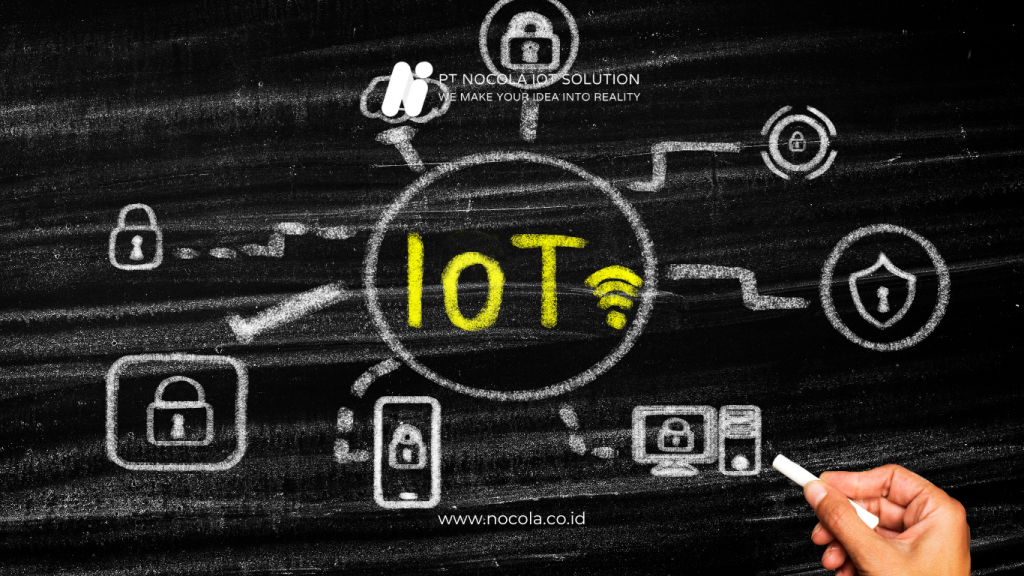
Monitoring delivers maximum value when it is integrated with the operational systems already used by the company. Sensor data should not stand alone, but become part of core business processes.
Integrating IoT with operational management systems allows field data to support activity records, daily reports, and performance evaluations. For example, equipment condition data can be linked directly to digitally recorded inspection and maintenance activities.
With this approach, companies can establish more structured workflows. When the system detects anomalies, maintenance tasks can be automatically created and assigned to relevant teams.
Integration also enables companies to connect IoT data with management dashboards, ERP systems, or other reporting platforms. This helps management gain a more comprehensive view of operational conditions.
This is where the role of an IoT platform becomes critical. A good platform not only displays sensor data, but also provides device management features, data visualization, API integration, and system security.
Furthermore, integrating IoT monitoring with digital systems such as field activity logs and inspection reports helps companies build a single, consistent source of data. Sensor data, technician activities, and supervisor reports can complement each other.
With an integrated system, companies not only know what is happening in the field, but can also track who performed an action, when it was done, and what the outcome was.
The need for monitoring without having to be constantly on site is no longer just a concept—it is a real necessity for modern enterprises. The Internet of Things has proven its capability as a real-time, accurate, and integrated remote monitoring solution.
Through sensors, connectivity, and digital platforms, IoT enables companies to continuously monitor asset conditions and operational processes. The results include improved visibility, faster response to disruptions, reduced operational costs, and better decision-making quality.
IoT monitoring also opens opportunities for integration with digital operational systems, allowing field data to directly support business processes, reporting, and performance evaluation. In manufacturing, energy, environmental monitoring, and facility management, IoT has become a critical foundation for digital transformation.
For companies that want to remain competitive, adopting IoT-based monitoring is not merely about following technology trends. It is a strategic step toward building more efficient, transparent, and future-ready operations.
